
A Craft Born in the Himalayas
Felt is one of the oldest textiles used in the Himalayan region. Long before factories and synthetic fibers, families in the hills of Nepal worked with what they had — sheep wool, warm water, natural soap, and their own hands. The method is simple in theory: wool fibers are layered, wetted, pressed, and rolled until they bind together. But in practice, it takes patience and rhythm.
The friction and pressure slowly tighten the fibers into a dense, durable fabric. No weaving. No knitting. Just compression and time. It is physical work. It is repetitive. And yet, there is something almost meditative about it.
At Jemu Home, this traditional wet-felting method is still followed. There is no rush to “speed up” what has always been slow. Because if you hurry, you lose the texture. You lose the soul of it.
The Material: Simple, Honest, Responsible
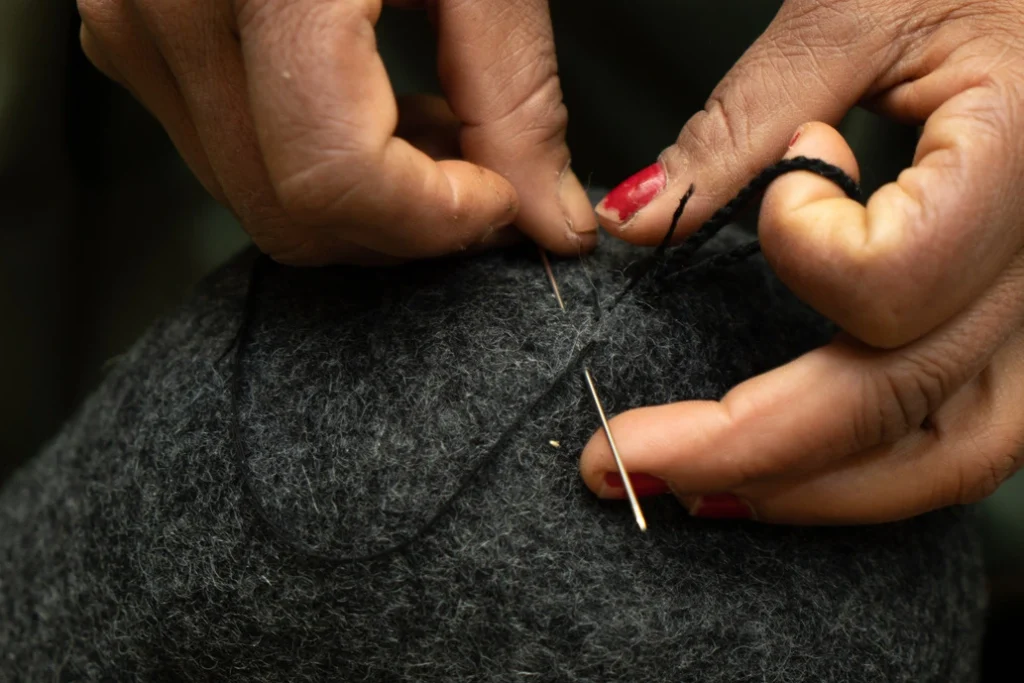
Wool felt is naturally breathable, biodegradable, and insulating. It regulates temperature, absorbs sound softly, and ages without falling apart. Unlike many industrial textiles, it does not rely on plastic-based fibers.
Sheep wool in Nepal is often sourced locally or regionally, supporting pastoral communities as well. Very little is wasted in the process. Scraps can be reworked into smaller items. Even the production setup is low-impact — water, soap, and manual labor.
In today’s language, we call this sustainable. But in reality, it is just traditional knowledge. People used what nature gave them and respected its limits. That is something modern manufacturing sometimes forgets.
Women, Work, and Dignity
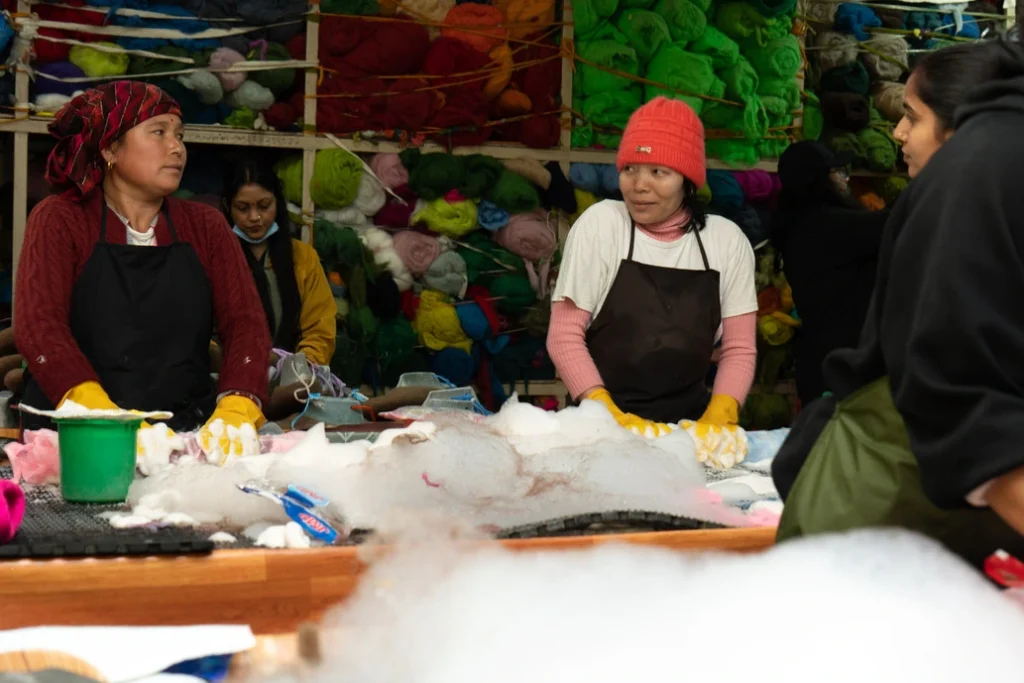
Felt production in Nepal is closely connected with women-led artisan groups and cooperatives. For many women, especially in semi-urban and rural areas, felt craft offers flexible, home-based income.
It allows them to contribute financially while staying connected to their families and communities. Skills are passed down informally — from mother to daughter, from neighbor to neighbor.
This is not fast fashion. It is community-centered production. It moves at human speed. And that changes the energy of the product itself. You can sense when something was made in stress versus when it was made with steadiness.
Softness as Strength
We often associate strength with hardness — concrete, steel, sharp lines. But felt challenges that idea.
Felt holds shape. It supports structure. A felt basket can carry weight. A felt rug can anchor a room. Yet it remains soft to the touch. That balance is important.
In many ways, Nepal’s mountain culture reflects the same philosophy. Life in the Himalayas demands resilience, but it also teaches harmony. Survival depends on working with nature, not against it.
Softness here is not weakness. It is adaptable. It is endurance without aggression. And maybe that is a lesson modern homes need.
Felt in the Modern Home
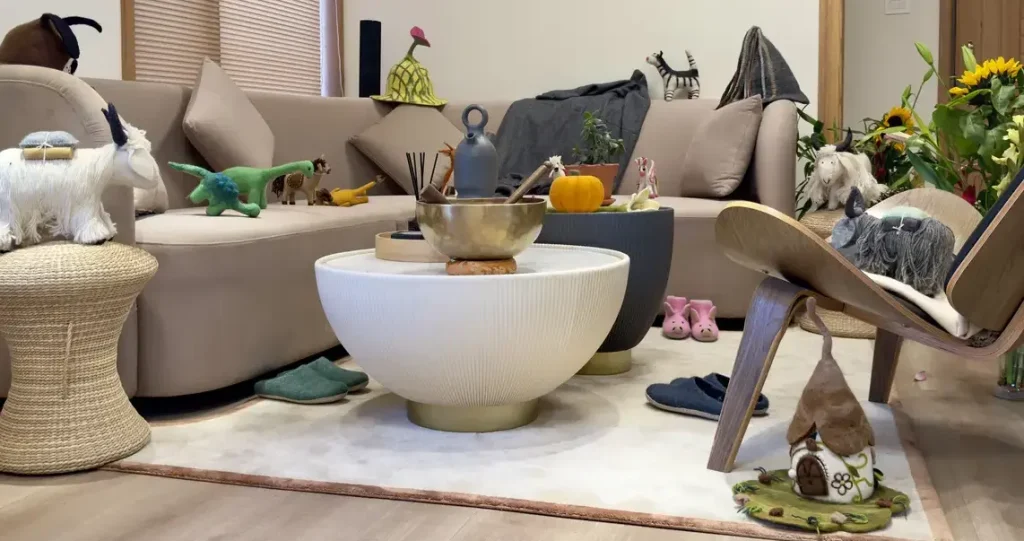
When a felt storage piece, decorative accent, or organizer enters a space, it does something subtle. It absorbs noise. It softens corners. It brings warmth without shouting for attention.
Minimalist interiors often struggle with feeling cold. Felt quietly solves that. It introduces texture and warmth without overpowering the design.
For someone who values cultural depth — the Cultural Connoisseur — felt is not just another decor object. It is a conversation between past and present. Between mountain heritage and contemporary living.
What Jemu Home Stands For
At Jemu Home, felt is not treated as a trend category. It is part of a broader belief in gentle living, homes built on intention, not excess.
Each felt piece carries human variation. Slight changes in thickness. A texture that feels real, not machine-perfect. These small differences remind us that beauty does not have to be identical to be valuable.
In a world that rewards speed, felt teaches patience. In a market that celebrates sharp edges, it offers curves and warmth.
And maybe that is the quiet power of Nepal’s felt craft, it shows that you do not have to be loud to be strong. Softness, when rooted in tradition and care, can hold its own.