If you’ve been sourcing pashmina for more than a season, you already know this isn’t really a simple “which is better” question. It’s more about what actually sells consistently, and what doesn’t come back later as a problem in bulk orders.
On the surface, the comparison feels obvious. Handmade means premium, machine-made means scalable. But once you move beyond small samples into real production, 200, 500, 1000 pieces, the differences become less theoretical and more operational.
And that’s where most decisions start to break down.
The Sampling Illusion Most Buyers Fall For
Handmade pashmina samples almost always win the first impression.
They feel softer. The weave has depth. There’s a natural irregularity that makes the piece feel unique. If you’re building a premium or story-driven brand, it’s very easy to say yes at this stage.
But sampling is not reality, it’s a controlled version of it.
The best artisans are usually assigned to sample development. Extra care goes into finishing. Imperfections are quietly filtered out. What you’re seeing is a “best case” version of handmade production.
Now try scaling that exact same quality across 300 pieces made over several weeks by multiple artisans.
That’s when variation enters the picture.
The Reality of Handmade in Bulk Production
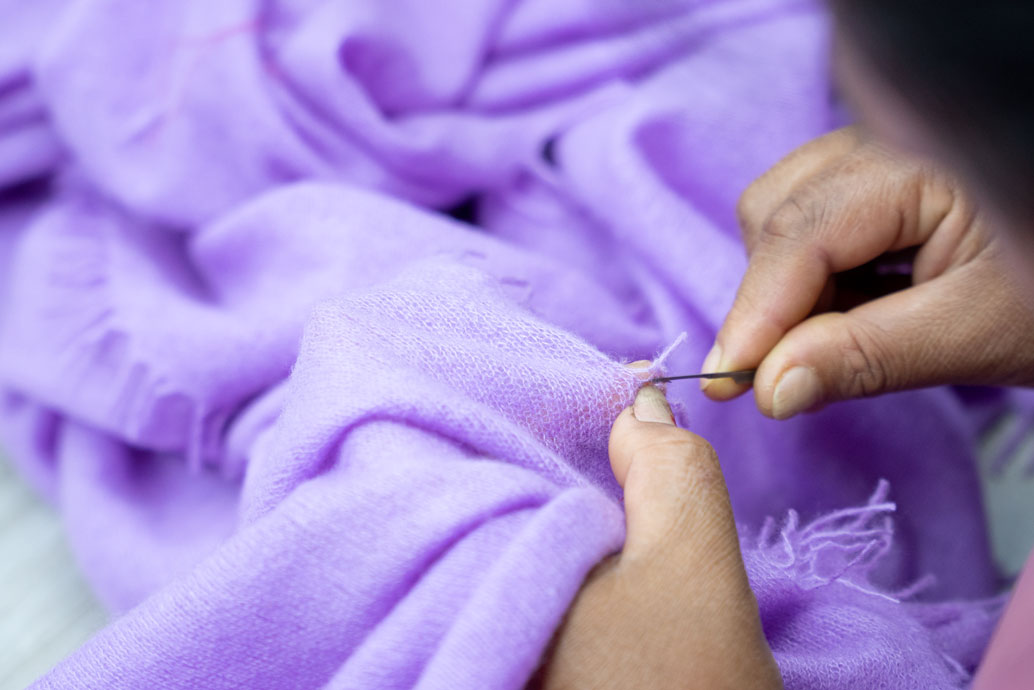
Handmade production is not uniform. Even with skilled artisans, you’re dealing with human variation.
One artisan weaves slightly tighter. Another works a bit looser. Yarn batches may differ subtly. Even environmental factors, humidity, temperature, can affect how the fiber behaves.
The result?
- Slight differences in texture
- Minor color tone shifts
- Inconsistent finishing details (edges, tassels, etc.)
Individually, each piece still looks good. But collectively, they may not look identical.
That becomes an issue if your business relies on:
- Repeat customers expecting the same product
- Retail chains needing consistency
- Online listings where customers compare items closely
This is where many “premium handmade” strategies start to struggle, not because the product is bad, but because expectations weren’t aligned with production reality.
Machine-Made: Less Emotion, More Control
Machine-made pashmina usually has the opposite problem.
The sample often feels too perfect. Too clean. Sometimes even slightly lifeless compared to handmade.
That turns off a lot of buyers early.
But what machine production does extremely well is consistency.
You approve one sample, and the next 500 pieces will look almost exactly the same:
- Same weave density
- Same color tone
- Same finishing quality
For businesses selling at scale, this reliability quietly becomes more valuable than the emotional appeal of handmade.
Especially in e-commerce, where consistency directly affects returns and customer trust.
When “Good Decisions” Backfire
This is where things get interesting.
A buyer chooses handmade for its premium story. Invests in beautiful samples. Builds branding around craftsmanship.
Then bulk production introduces variation.
Customers notice differences. Returns increase. Or the second batch doesn’t match the first, and now you have a continuity problem.
On the other side, a buyer goes fully machine-made for efficiency.
Everything is consistent, but the product lacks differentiation. It becomes harder to stand out. Pricing pressure increases.
Both decisions are logical. Both can fail, if the business model doesn’t support them.
MOQ: What Looks Flexible Isn’t Always Practical
MOQ (Minimum Order Quantity) is another area where expectations and reality don’t match.
Handmade pashmina often comes with lower MOQs on paper, sometimes 30 to 50 pieces. That sounds ideal for testing designs.
But smaller handmade batches create hidden challenges:
- Less production efficiency
- More switching between designs
- Higher cost per piece
- Greater variation between batches
Machine-made production usually requires higher MOQs, 100, 200, or more.
That feels restrictive at first.
But once you commit, things stabilize:
- Better cost control
- Streamlined production
- More predictable timelines
So the question isn’t just “what’s the MOQ?” but “what happens because of that MOQ?”
Sampling vs Bulk: Where Most Mistakes Happen
This is probably the biggest gap in understanding.
Sampling is optimized to impress you.
Bulk production is optimized to deliver volume.
For handmade, that means:
- Multiple artisans working simultaneously
- Slight interpretation differences in the same design
- Inconsistencies in finishing details
For machine-made, it means:
- High-speed production
- Less individual attention per piece
- Dependence on precise setup
Common issues we see:
Handmade bulk problems
- Uneven tassels
- Slightly inconsistent edges
- Variation in softness
Machine-made bulk problems
- Slightly stiffer feel than sample
- Finishing not as refined unless specified
- Minor deviations if specifications weren’t clear
These aren’t supplier failures. They’re production realities.
Delays and Communication: Different Problems, Same Impact
Both methods come with risks, but they show up differently.
Handmade production:
- More vulnerable to delays from artisan availability
- Harder to track progress accurately
- Timelines can shift gradually
Machine production:
- More predictable overall
- But delays tend to be larger when they happen
- Issues affect the entire batch at once
From the outside, delays feel like poor management.
From the inside, they’re often about how the production system is structured.
What Suppliers Deal With (That Buyers Don’t See)
Behind the scenes, both types of production require very different management.
Handmade orders involve:
- Coordinating multiple artisans
- Monitoring consistency manually
- Fixing small issues before they scale
Machine-made orders involve:
- Precise technical setup
- Strict process control
- High risk if something is misconfigured early
This is why experienced suppliers ask a lot of questions upfront.
Not to complicate things, but to prevent predictable problems later.
The Details Buyers Usually Don’t Define (But Should)
For handmade orders, one critical question is:
What level of variation is acceptable?
Most buyers don’t define this clearly. But it matters.
- How much color variation is okay?
- Should tassels be identical or just similar?
- Is slight texture difference acceptable?
Without clear answers, expectations and outcomes drift apart.
For machine-made orders, the focus shifts to precision:
- Exact GSM (weight)
- Weave structure
- Finishing process
- Color references
Vague instructions lead to technically correct, but commercially disappointing, results.
The Hybrid Approach That Quietly Works
There’s a middle ground that more buyers are moving toward.
Machine weaving combined with hand finishing.
This approach offers:
- Consistency in structure
- A touch of handmade character
- Better scalability than full handmade
It’s not the cheapest option, and it’s not the most “authentic” in a traditional sense.
But commercially, it often performs very well, especially in the mid-range market.
So, What Actually Sells Better?
There’s no universal winner here.
What sells better depends on how you sell.
If your brand is built on:
- Craftsmanship
- Storytelling
- Uniqueness
Then handmade can work very well, if you manage expectations around variation.
If your business depends on:
- Consistency
- Repeatability
- Scalable growth
Then machine-made is usually the safer choice.
Most sourcing problems don’t come from choosing the wrong type.
They come from choosing without understanding what comes with it.
A More Practical Way to Decide
Instead of asking “which is better,” ask:
- How sensitive are my customers to variation?
- Do I need consistency across repeat orders?
- Am I selling a story, or a standardized product?
- Can I handle slight inconsistencies operationally?
Answer those honestly, and the decision becomes much clearer.
Final Thought
Most buyers only fully understand this after a few imperfect bulk orders.
That’s normal.
But if you can anticipate where things usually go wrong, sampling illusions, MOQ trade-offs, bulk inconsistencies, you can avoid a lot of unnecessary friction.
And more importantly, you can choose a direction that actually works for your business, not just one that looks good in a sample.